 |
|
|
Class 43 HST |  |

|
|
||
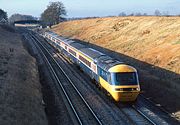 |
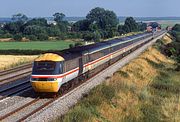
The first production HST power car, 43002 is pictured at Baulking on 5 December 1981 working the 11:10 Cardiff Central to Paddington service. It has just passed the site of Uffington station, which was situated near the bridge in the background. This was the junction for the Faringdon branch, which curved away to the right by the trees. It closed to passenger traffic in 1951 and freight in 1962. In 1981 the view was completely unobstructed from Baulking to Uffington, with even the former Junction Hotel clearly visible. |
|
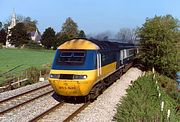 |
43002 passes Little Bedwyn on 22 October 1983 with the 1B72 12:45 Paddington to Plymouth service. St Michael's church, with its 600 year old spire, must have featured in thousands of railway pictures from the days of steam, to the present day. This picture is taken from the steps of a footbridge that crosses both the railway and the Kennet & Avon Canal. |
|
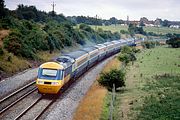 |
Just four days after being named Top of the Pops, 43002 passes Hungerford Common on 3 September 1984 with the 1A73 05:07 Penzance to Paddington 'Golden Hind'. There was some controversy at the time that a loco was being named after a popular TV programme, but strangely nobody was bothered by who actually maned it - Jimmy Savile! The old Hungerford Hospital (originally the Hungerford and Ramsbury Workhouse) can be seen in the background. This was demolished in the late 1990s, leaving only the small chapel that can be seen on the right. |
|
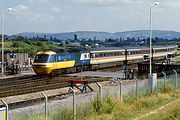 |
The first production HST power car, 43002 received the name Top of the Pops on 30 August 1984, and the nameplate can clearly be seen in this view as it arrives at Gloucester with the 10:39 Manchester Piccadilly to Plymouth service on 21 August 1985. The train is just crossing over the Horton Road level crossing, a notorious traffic bottleneck, which this train will again traverse after reversing at Gloucester station, as all north to south services have to do. It will depart on the lines in the foreground. |
|
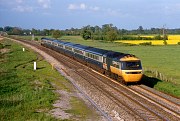 |
43002 Top of the Pops leads the 18:05 Paddington to Bristol Temple Meads service towards the site of Ashbury Crossing at Shrivenham on 29 May 1986. The remains of the former unit number (253001) can just be seen under the driver's windscreen. The practice of referring to HSTs by a unit number was discontinued shortly after this revised livery was applied in the mid 1980s. Superb evening lighting here, in a picture which is taken from the north side of the line, an angle which is only possible on mid summer evenings or on a cloudy day. |
|
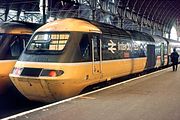 |
43002 Top of the Pops stands on the blocks at Paddington station on 22 November 1986, shortly after arriving with the 1A24 07:30 service from Plymouth. When this picture was taken it had only been working trains out of Brunel's magnificent station for a decade. I doubt if anyone in those days would have thought it would still be doing it three decades later! |
|
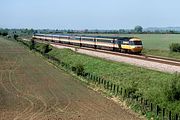 |
Almost three decades before it became the specially repainted power car that everybody wanted to photograph wherever it went, 43002 Top of the Pops approaches Circourt Bridge, Denchworth, on 8 May 1987 with the 1A39 10:35 Swansea to Paddington service. The loco lost its proper cast Top of the Pops nameplates the following year, but had a set of cheap looking reflective plates added in 1991, before these too were removed in 1996. |
|
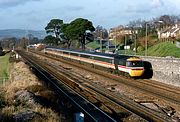 |
43002 passes Aller on 7 December 1988 with the 1V42 07:45 Leeds to Paignton 'Devonian'. Unfortunately this view is no longer possible, as the farm occupation bridge that crossed the line here was demolished on Christmas Day 2013 in connection with the A380 road improvement scheme. This is the short four tack section of line between Newton Abbot and the Aller divergence, with the Paignton lines on the right, and the Penzance lines on the left. |
|
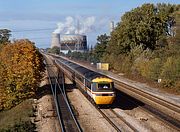 |
The remnants of 43002's former livery, which included yellow paint instead of grey around the windscreen, can be seen as it leads the 1A38 10:20 Bristol Temple Meads to Paddington service past South Moreton (Didcot East) on 24 October 1989. As always it is the horse chestnut tree that starts off the autumn colour spectacle. |
|
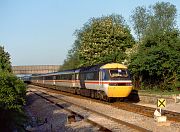 |
43002 Top of the Pops catches the evening sun as it passes the remains of Wantage Road station on 17 May 1992 with the 18:35 Paddington to Swindon service. Normally this train would have continued on via the Golden Valley route to Cheltenham, but that line was closed for engineering works. 43002's peeling paint shows traces of its former all yellow front end, an experimental livery carried by a handful of power cars during 1988. Didcot Power Station can just be glimpsed underneath the roadbridge in the background. |
|
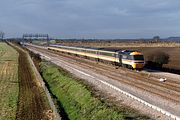 |
A few minutes of brilliant lighting conditions during an otherwise cloudy day luckily corresponded with 43002 Top of the Pops leading the 1A44 10:15 Bristol Temple Meads to Paddington service past Circourt Bridge, Denchworth, on 25 November 1993. This was running approximately 15 minutes late, which was very fortunate, as at the booked time the scene looked nothing like this! The dark clouds in the background certainly make the picture, but note that the hedges and trees in the distance are in the shade, emphasising how brief this superb lighting was. |
|
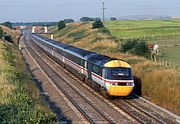 |
A picture containing two white horses. In addition to the one in the field, just about visible on the hill on the horizon is the 3,000 year old Uffington White Horse, which gives its name to the Vale. 43002 Top of the Pops passes Bourton on 25 July 1995 with the 1B62 18:30 Paddington to Swansea InterCity service. |
|
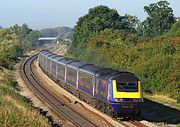 |
Just over thirty years since being introduced onto the Great Western Mainline, the first production HST power car 43002 was still going strong on 8 September 2006, when it was pictured approaching Compton Beauchamp with the 07:00 Swansea to Paddington service. The clear early morning autumn light prompted the use of a long lens to emphasize the reverse curves here, proving that Brunel's GWR main line is not completely featureless. The concrete footbridge in the background is on the site of Ashbury Crossing, near Shrivenham. |
|
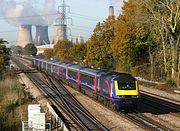 |
With the unmistakable background of Didcot Power Station, 43002 Techniquest passes South Moreton (Didcot East) on 12 November 2007 with the 1L42 08:29 Swansea to Paddington First Great Western service. Not the mix of liveries throughout the coaches. |
|
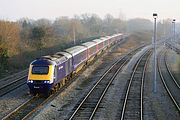 |
43002 passes Hinksey Yard on 30 December 2008 with the 1D39 13:51 Paddington to Oxford First Great Western service. Note that there is still one coach in the train carrying FGW's original version of their blue livery. |
|
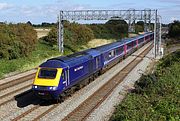 |
Still giving excellent service after 34 years in traffic (over double the length of time the 'Westerns' plied this route), the first production HST power car, 43002 heads west past Denchworth on an intermittently sunny 16 September 2010 with the 1C16 13:30 Paddington to Bristol Temple Meads First Great Western service. Admittedly now with a different engine, this power car must have clocked up an astronomical mileage, and surely makes the class one of BR's best value for money decisions ever. |
|
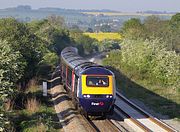 |
I hope the driver of 43002 isn't scratching his head because he thinks he's running 'wrong line'! Seriously, the pioneer HST power car leads the 1P21 05:34 Hereford to Paddington First Great Western service past Chilson on 4 May 2011, passing the recently re-laid, but not yet ballasted re-instated up line. |
|
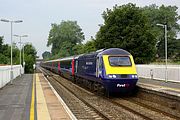 |
43002 races through Pewsey station on 23 August 2013 with the 1A74 05:53 Plymouth to Paddington First Great Western service. Although not obvious from this picture, there were numerous passengers waiting to board the following stopping service headed by 43023, which arrived a mere four minutes later. |
|
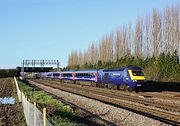 |
Crisp early morning light at Challow on 2 January 2014, as 43002 heads towards London with the 1L38 07:58 Swansea to Paddington First Great Western service. Note the new fence in the foreground - thankfully not one of Network Rail's preferred palisade monstrosities! |
|
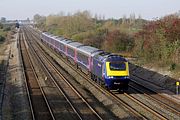 |
43002 passes milepost 62, near Denchworth, on 31 October 2014 with the 1L38 07:58 Swansea to Paddington First Great Western service. The use of a long lens here is in order to shoot through a huge signal gantry that would otherwise dominate the foreground. |
|
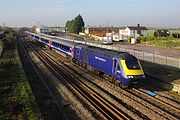 |
A wide angle view of the remains of Shrivenham station, taken on 29 November 2014. Note the Fat Dog pub in the background, with the former railwaymen's cottages in the background. 43002 races past with the 1A13 10:30 Bristol Temple Meads to Paddington First Great Western service. |
|
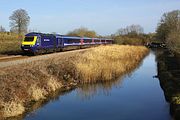 |
A fatality in the Reading area caused the last minute diversion of certain First Great Western services via the Berks & Hants line on the morning of Saturday 24 January 2015. One such was the 1C10 10:27 Paddington to Bristol Temple Meads, seen here running alongside the Kennet & Avon Canal near Crofton, led by 43002. |
|
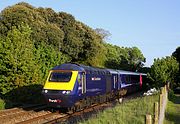 |
43002 is still accelerating away from Kemble station, as it passes the site of Coates goods station on 16 May 2015 with the 1G60 18:15 Paddington to Cheltenham Spa First Great Western service. Originally opened as Tetbury Road passenger station with the opening of the line in 1845, the station closed to passengers in 1882, being replaced by the junction station at Kemble (a short distance to the south). In 1908 it was renamed Coates. For over 80 years it operated as a purely goods station, being conveniently situated next to the Fosse Way (now the A433). |
|
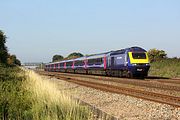 |
A wave from the driver of 43002, as he approaches the public footpath crossing near Grove on 28 September 2015 with the 1L38 07:58 Swansea to Paddington GWR service. As is often the case, this completely cloud free scene did not last much longer, with the usual midday cloud soon bubbling up. |
|
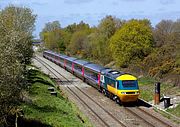 |
Still looking pristine, just two days after it was unveiled to the public in its new 'old' livery, 43002 Sir Kenneth Grange passes Baulking on 4 May 2016 with the 1A13 10:30 Bristol Temple Meads to Paddington GWR service. To celebrate 40 years of the iconic HST, the first production power car was chosen to be repainted into its original (and arguably the best) livery. Fittingly, it was named the train's designer, Sir Kenneth Grange, at the St Philips Marsh Open Day on 2 May. This picture makes an interesting comparison to my 1981 view of the same loco at the same spot. A lot has changed in 35 years, but now that 43002 is back in its original livery there is one constant. The steel piles either side of the track show that a monumental change is about to alter the view totally. |
|
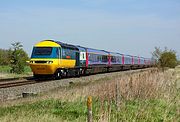 |
43002 Sir Kenneth Grange approaches Radley on 5 May 2016 with the 1P39 11:01 Oxford to Paddington GWR service. The immaculate blue and grey power car does look slightly odd with a rake of GWR's blue 'wavy line' coaches, but unfortunately the repainting of a matching set of stock was never really likely to happen. However, the 1970s retro liveried loco has become an instant hit, and is quite rightly photographed everywhere it goes. I've been saying for years that at least one power car should be repainted into this iconic colour scheme, and so I'm really pleased to see the first production power car honoured in this way. It's funny how few people gave it a second glance when it looked like this (minis nameplates) 40 years ago! |
|
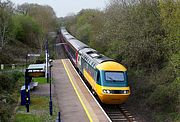 |
43002 Sir Kenneth Grange leads the late running 1P65 15:14 Hereford to Paddington GWR service through the diminutive Finstock station on 6 May 2016. Finstock is served by only two trains a day, and in fact the only down train to call was delayed on this occasion, as 43002 and its train would have to clear Wolvercote Junction before the local could proceed onto the single line. |
|
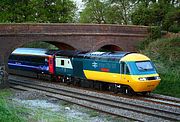 |
43002 Sir Kenneth Grange bursts out from underneath the road bridge at Compton Beauchamp on 8 May 2016 with the 1C28 19:27 Paddington to Bristol Temple Meads GWR service. With the sun having long since disappeared into a bank of cloud, and the time being 20:23, to say the light was poor would be an understatement! In order to use the 1/2000sec shutter speed that this close up view required, I had to use ISO 6400 and the lens wide open at f2.8! |
|
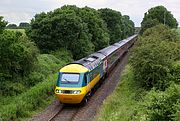 |
43002 Sir Kenneth Grange passes Stoulton on 18 June 2016 with the 1P51 12:41 Great Malvern to Paddington GWR service. This was a very welcome surprise, as I hadn't checked up to see where this power car was. The bridge in the background marks the site of the derailment of the 1A75 07.05 Hereford to Paddington train on 30 November 1984, caused by a broken fishplate. |
|
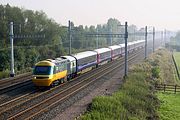 |
A sunny, but very misty morning at Circourt Bridge, Denchworth, on 14 September 2016. 43002 Sir Kenneth Grange passes underneath the half complete overhead catenary with the 1C06 08:30 Paddington to Bristol Temple Meads GWR service. |
|
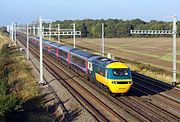 |
43002 Sir Kenneth Grange brings up the rear of the 1B12 08:15 Paddington to Swansea GWR service at Circourt Bridge, Denchworth, on 10 October 2016. Coincidentally, GWR's other heritage repaint, 43185 Great Western had passed by in the other direction just ten minutes earlier. |
|
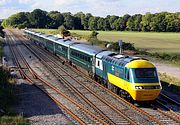 |
This must be deliberate! Both of GWR's recently repainted 'heritage liveried' power cars, sandwiching one of their rakes of green coaches. 43002 Sir Kenneth Grange leads the 1A83 10:00 Penzance to Paddington service past Woodborough on 11 October 2016, with 'InterCity Swallow' liveried 43185 Great Western bringing up the rear. Typically after standing around for over two hours in unbroken sunshine, just at the critical moment a cloud partially got in the way. I suppose we were lucky to get any sun, as earlier in the day it had been very foggy, and there was still a lot of cloud around, both to the north and south of this location. |
|
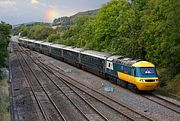 |
43002 Sir Kenneth Grange passes Standish Junction on 12 October 2016 with the diverted 1L82 15:28 Swansea to Paddington GWR service. 'InterCity Swallow' liveried 43185 Great Western is bringing up the rear, with Laira's LA16 set of green coaches completing the multi-coloured picture. This was the second day in traffic for this odd combination. After a reasonably sunny afternoon, the clouds were now building up big time, and the small rainbow in the background indicates that the Cotswolds are getting some rain. I know this for certain, as I drove through it on the way home! |
|
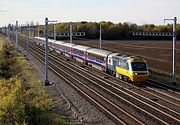 |
43002 Sir Kenneth Grange passes underneath the newly installed steel eyesores at Circourt Bridge, Denchworth, on 2 November 2016, as it heads towards the capital with the 1A19 13:30 Bristol Temple Meads to Paddington GWR service. |
|
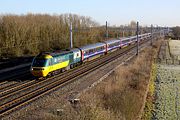 |
43002 Sir Kenneth Grange passes Circourt Bridge, Denchworth, on 5 January 2017 with the 1C07 09:00 Paddington to Bristol Temple Meads GWR service. Although it is hidden by a mast, the rear power car is another unique liveried power car - 43172 Harry Patch - The last survivor of the trenches. | |
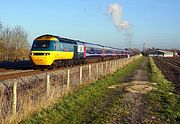 |
A superb end to a superb day's photography. 43002 Sir Kenneth Grange races past Steventon on 5 January 2017 with the 1C17 14:00 Paddington to Bristol Temple Meads GWR service. Not having called at Didcot, this was going noticeably faster than some of the HSTs seen earlier in the day, although easily stopped with a shutter speed of 1/2000sec. Another one of the route's non-standard liveried power cars, 43172 Harry Patch - The last survivor of the trenches is on the rear of the train. |
|
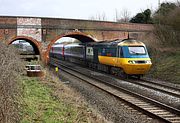 |
43002 Sir Kenneth Grange passes underneath Steventon roadbridge on 1 March 2017 with the 1C12 11:30 Paddington to Bristol Temple Meads GWR service. This bridge is the subject of a bitter feud between the locals, who want to preserve it, and Network Rail who wish to demolish it. The cause of all this is the hugely delayed electfrication of the Great Western Mainline. Note the two concrete filled mast bases on the left, and also the white sighting patch on the bridge, a remnant from the days of semaphore signalling. |
|
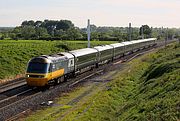 |
43002 Sir Kenneth Grange passes Compton Beauchamp on 13 May 2017 with the GWR 1Z67 15:55 Bishops Lydeard to Paddington 'Somerset Explorer' railtour. Newly repainted 43093 is on the rear of the train. Originally the train was booked to travel along the West Somerset Railway to Minehead, but gauging issues resulting in tour participants travelling to the town behind D1010 Western Campaigner insead. Normally I would I have travelled to Somerset to photograph this, but I had only just returned from the Isle of Man, so this backlit local picture will have to suffice. |
|
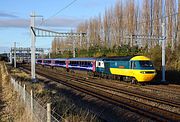 |
43002 Sir Kenneth Grange passes Challow on 28 November 2017 with the 1A09 07:13 Taunton to Paddington GWR service. Earlier in the month 43002 had acquired a coupling cover from a blue liveried power car, giving it a very odd appearance. Naturally this was only going to be a short term fix, and I didn't manage to get a picture of it. However, this newly painted replacement looks a bit odd, being a darker shade of yellow, and with the set number in a non-standard small font. |
|
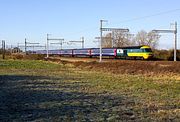 |
43002 Sir Kenneth Grange passes Grove on 30 November 2017 with the 1L38 07:59 Swansea to Paddington GWR service. Strange as it seems, this location has actually got marginally more photogenic since the electfrication wires went up! Before the wires were installed, a high voltage electricity line crossed the railway here. It now goes underground, from the post seen on the extreme left of the picture. Whereas the catenary is a necessary eyesore on an electrified railway, the high voltage wires in an otherwise open landscape completely ruined the picture. |
|
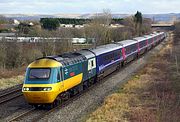 |
43002 Sir Kenneth Grange passes Badgeworth on 2 February 2018 with the 1L58 12:36 Cheltenham Spa to Paddington GWR service. Note the darker coloured coupling cover, featuring an incorrectly small sized set number. This was fitted in late 2017, after the power car ran for a while with a First Great Western blue panel. |
|
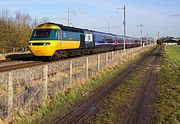 |
43002 Sir Kenneth Grange passes Steventon on 16 February 2018 with the 1B46 14:45 Paddington to Swansea GWR service. I had noted this on the rear of the 1A17 12:30 Bristol Temple Meads to Paddington a couple of hours earlier, and therefore made sure I was in the best possible position to get a decent picture of this iconic power car in the perfect late afternoon winter light. Although this location is one of the few in the area that is not fully wired, the view still compares unfavourably with the same location a year earlier, when 43002 was also photographed here. |
|
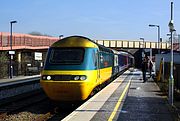 |
43002 Sir Kenneth Grange arrives at Honeybourne station on 24 February 2018 with the 1W29 11:22 Paddington to Great Malvern GWR service. Definitely not the ideal photographic vantage point, but at least it is a clearly identifiable location. |
|
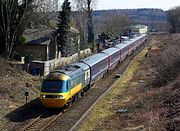 |
43002 Sir Kenneth Grange pulls away from Hanborough station on 21 March 2018 with the 1W01 10:22 Paddington to Hereford GWR service. At 42 years, 43002 may now be considered old, but there is something even older in the background. Just visible in the doorway of the Oxford Bus Museum is City of Oxford Motor Services AEC Renown double decker FWL 371 E of 1967. |
|
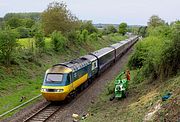 |
The Network Rail worker takes a break from feeding branches into the shredder, as 43002 Sir Kenneth Grange passes Cornbury Park on 9 May 2018 with the 1P40 17:38 Moreton-in-Marsh to Paddington GWR service. This is the only southbound train of the day not booked to call at Charlbury station. The station is just out of sight around the corner, and consequently this was travelling at some speed. Network Rail's massive vegetation clearance has come in for severe criticism, especially as it is taking place during the nesting season. Rather than routine maintenance, which was practiced until the 1980s, nothing at all was done on the Cotswold Line (and other locations) until the lineside got so bad that in many places the bushes were touching the train. |
|
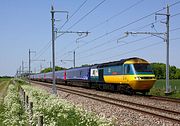 |
With the level crossing a short distance ahead having just been struck by a lorry, 43002 Sir Kenneth Grange slowly approaches a red signal at Steventon on 15 May 2018 with the 1A79 06:47 Penzance to Paddington GWR service. And yes, the left hand mast really is leaning considerably to the left. More shoddy Network Rail work! |
|
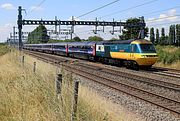 |
43002 Sir Kenneth Grange passes Challow on 11 July 2018 with the 1L55 11:29 Swansea to Paddington GWR service. Although obviously severely disfigured since the installation of the overhead electfrication, this location still offers views in both directions, with various viewpoints available, merely by walking further up the field. |
|
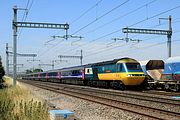 |
43002 Sir Kenneth Grange very slowly passes Grove on 12 July 2018 with the 1A79 06:47 Penzance to Paddington GWR service, passing the ex National Power wagons of the 6M20 09:23 Whatley Quarry to St Pancras (Churchyard Sidings) stone train, led by 66137, which inexplicably was being let out of the relief line in front of the HST! The HST came to a stand a little further on, while the slow moving freight headed off towards Didcot. At this point both trains were doing about 40mph, so there was no way that I needed the 1/2000sec shutter speed that I had set the camera to, thinking that the HST would be overtaking the freight at speed as it passed me! |
|
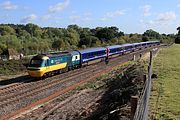 |
43002 Sir Kenneth Grange brings up the rear of the late running 1A77 05:41 Penzance to Paddington GWR service at Hungerford Common on 24 September 2018. 43177 is the lead power car. Extensive tree clearance has taken place here, as evidenced by the tree stumps, and huge pile of wood chippings. |
|
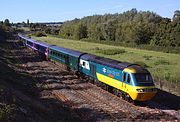 |
43002 Sir Kenneth Grange passes Hungerford Common on 27 September 2018 with the 1A85 10:00 Penzance to Paddington GWR service. An interesting mix of 1970s heritage livery, GWR green, and First Great Western blue! The Kennet & Avon Canal runs between the hedge and the wood in the background. |
|
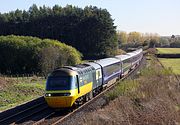 |
43002 Sir Kenneth Grange passes Churchill Heath on 22 October 2018 with the 1W25 12:21 Paddington to Worcester Shrub Hill GWR service. Extremely backlit, but I never miss an opportunity to photograph 43002, especially as it is soon to go off lease. |
|
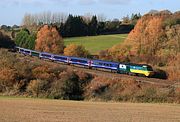 |
43002 Sir Kenneth Grange sweeps round the reverse curves near Hungerford on 13 November 2018 with the 1A77 05:41 Penzance to Paddington GWR service. A perfect combination of a sunny morning and superb autumn foliage was made even better by the appearance of the iconic 1970s liveried power car. The only tiny minus point is the inclusion of a couple of random drab green coaches in an otherwise blue rake. |
|
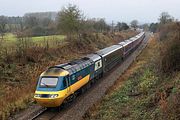 |
The end of Cotswold Line HSTs! It certainly is the end of this particular train, as 43002 Sir Kenneth Grange brings up the rear of the 1W01 10:22 Paddington to Hereford GWR service at Cornbury Park on 5 December 2018. 43171 is leading the train towards its next stop at Charlbury station, which can be seen in the distance. With the Class 800 DMUs rapidly taking over, this could possibly be one of my last Cotswold Line HST pictures. |
|
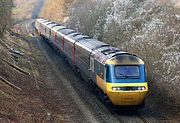 |
43002 Sir Kenneth Grange brings up the rear of the 1W27 13:22 Paddington to Worcester Foregate Street GWR service at Whitehill (between Combe and Finstock) on 14 December 2018. Definitely not ideal lighting, but a record of the iconic 1970s liveried first production power car in the dying days of the class's use on the Cotswold Line. 43197 was the leading power car. |
|
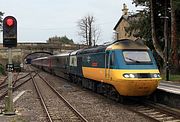 |
43002 Sir Kenneth Grange arrives at Kemble station on 3 January 2019 with the 1G38 13:36 Paddington to Cheltenham Spa GWR service. As a bonus, InterCity liveried 43185 Great Western was on the rear. This was running late, as the 3Q64 10:20 Canton Pullmans to Canton Pullmans Network Rail test train had bizarrely been let out of Swindon directly in front of it, instead of waiting for its booked time, which was to follow this train. The delay got worse, as the HST followed the test train down the 'Golden Valley'. It arrived at Gloucester 28 minutes late, it was terminated there. |
|
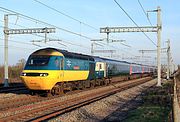 |
Nearly 43 years old, and still going strong, but unfortunately now with just a few weeks left on the Great Western Mainline. 43002 Sir Kenneth Grange races past Challow on 4 January 2019 with the 1B37 13:15 Paddington to Cardiff Central GWR service. InterCity liveried 43185 Great Western can just be seen on the rear, but the 25kV catenary posts prevented me getting a going away shot. I did try running along the edge of the field to get past the posts, but with the train doing 125mph, that was never going to work! |
|
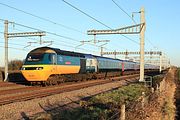 |
Moments before the sun faded out into a bank of cloud near the horizon, 43002 Sir Kenneth Grange passes Challow on 17 January 2019 with the 1B46 14:45 Paddington to Swansea GWR service. This was just a couple of weeks after I had photographed 43002 at very nearly the same spot, in similar light. On that occasion my vantage point was a little further along the lineside fence seen on the right. |
|
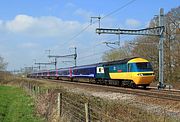 |
43002 Sir Kenneth Grange passes Uffington on 29 March 2019 with the 1A12 07:48 Paignton to Paddington GWR service. This is my first picture of this loco since its recent clean up, which included the removal of the 253001 set number from the coupling cover. The clouds in the background are an indication that yet again the BBC weather forecast had been over optimistic, with their prediction of a cloud free day. There were even more clouds to the south, and just after this train passed, the sun disappeared. A very close call! |
|
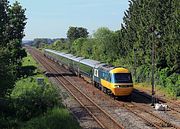 |
43002 Sir Kenneth Grange approaches Moreton-in-Marsh on 1 June 2019 with the GWR 1Z23 07:37 Paddington to Carmarthen 'Flying Banana' railtour. A nice touch for this farewell railtour was the use of the first and last production power cars, as 43198 Driver Brian Cooper 15 June 1947 - 5 October 1999 is bringing up the rear. Four of Moreton's semaphore signals can be seen in this view. The down inner home and down refuge are on the right, while just visible in the distance are the up advance starter, and the down outer home. |
|
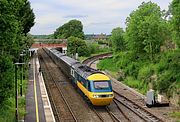 |
43002 Sir Kenneth Grange passes through Kemble station on 1 June 2019 with the GWR 1Z24 13:49 Carmarthen to Paddington 'Flying Banana' railtour. This was part of a mammoth charity tour to celebrate 43 years of Britain's most successful ever train. Although they will live on as shorter sets on the former Western Region, this train is the final full length HST set to operate on the Western. Although HSTs have been a regular sight at Kemble for virtually all of their 43 years, this is the first time that I have seen one go through the station non-stop, at full line speed. |
|
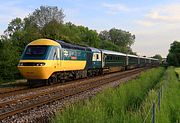 |
HST sunset! 43002 Sir Kenneth Grange brings up the rear of the very last standard length GWR HST operated train, the 1Z25 18:57 Paddington to Plymouth 'Flying Banana' railtour, as it passes Great Bedwyn on 1 June 2019. 43198 Driver Brian Cooper 15 June 1947 - 5 October 1999 was leading. There were obviously lots of photographers beside the Kennet & Avon Canal a little further on at Crofton, judging by the fanfare of horns as the train disappeared into the distance. Although it is excellent news that 43002 is going to be preserved, it is not so good that it is the National Railway Museum that is claiming it, as they have a poor record at looking after modern traction exhibits. Look what happened to a fully working 50033 Glorious, after a few years in their 'care'. |
|
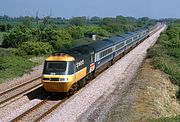 |
43003 leads the 1B30 13:00 Paddington to Swansea service past Circourt Bridge, Denchworth on 8 May 1987. It seems to be loosing its former set number 253001 piecemeal, with just the 253 left on the front end. By this time they had long since been regarded as locomotives, and were no longer kept in their original sets. In fact, I had seen 253001's former partner (43002) heading in the same direction on a another train approximately an hour earlier. |
|
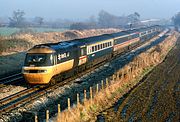 |
43003 passes Shrivenham on 10 December 1987 with the 1C47 13:30 Paddington to Bristol Temple Meads service. Around this time it was quite common to see sets of blue and grey coaches working with the then new InterCity executive liveried power cars, and vice versa, but it was less common to see mixed liveries within the coaches. |
|
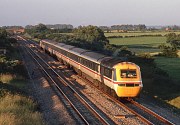 |
Although it is well known that the buffer fitted surrogated DVT HSTs received a modified version of InterCity livery, with yellow around the windscreens, it is less well known that for a short period in 1988 several conventional power cars also carried this livery. Catching the last rays of the setting sun, 43003 approaches Circourt Bridge, Denchworth on 22 June 1988 with the 20:00 Paddington to Swansea service. Despite it being close to the longest day, this picture was taken so near to sunset that Kodachrome 200 was required, hence the poor technical quality. |
|
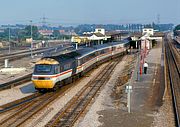 |
43003 takes the Oxford line at Didcot on 31 July 1992, as it pulls out of the station with the 17:10 Paddington to Hereford service. It is being closely followed by Class 117 unit L417 (just visible in the distance) with the 17:21 Reading to Oxford local service. As the HST was running late, the unit was now catching it up, although having to be held back while the HST weaved across from the fast lines in front of it has had a delaying effect. Note that apart from a couple of stone hoppers this end of the yard at Didcot is surprisingly empty. |
|
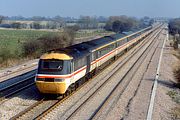 |
43003 approaches Circourt Bridge, Denchworth, on Sunday 20 February 1994 with the 12:30 Paddington to Swansea InterCity service. This was a time of transition at this location. The relief lines had just been installed, and while the down line was in use, the up line had yet to be commissioned. Also new at this time was the Denchworth road bridge in the background, along with the adjacent signal gantry. 43003 was not quite so new, although being just 18 years old, it was still only a short way into its very long career. |
|
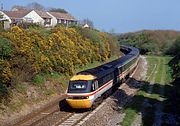 |
43003 rounds the sharp curve at South Brent on 1 May 1994 with the 1C46 13:35 Paddington to Plymouth service. On the right is the trackbed of the former Kingsbridge branch. This closed on 9 September 1963, although because the local bus company's replacement timetable didn't come into force for another week, passenger services on the line had a week's reprieve! |
|
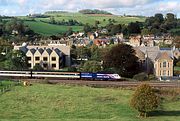 |
43003 passes King's School, Bruton, on 27 October 2001 with the 1A49 09:40 Penzance to Paddington 'Cornish Riviera'. This was transition time for First Great Western, with the power car being in their then new (and unfortunately short lived) blue and white livery, while the coaches are still in the former green and white colour scheme. |
|
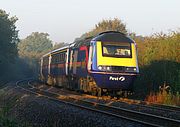 |
The second production HST power car, 43003 Isambard Kingdom Brunel was one of the diminishing number of First Great Western HSTs to retain its Paxman Valenta engine at the end of 2007. It is pictured here leaning into the curve and catching the first rays of the early morning sun between Shipton and Ascott-under-Wychwood with the 1P26 06:09 Abergavenny to Paddington 'Cathedrals Express' First Great Western service on 23 October 2007. |
|
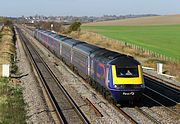 |
43003 Isambard Kingdom Brunel approaches Cholsey on 12 November 2007 with the 1A14 11:00 Bristol Temple Meads to Paddington First Great Western service. Although by this time 43003 was one of the few power cars to retain this version of FGW's livery, there were still many more coaches to be repainted. Here we have a mixed rake. |
|
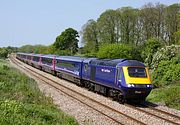 |
43003 Isambard Kingdom Brunel speeds past the site of Patney & Chirton station with the 1A81 08:42 Penzance to Paddington First Great Western service on 11 May 2009. Presumably the lilac tree in the background is a remnant of the long closed station. Despite the cloudless conditions, it was not that warm due to a near gale force wind. |
|
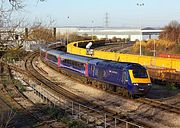 |
43003 Isambard Kingdom Brunel rounds the curve between Didcot North Junction and Didcot Parkway station on 10 December 2009 with the 1P43 12:31 Oxford to Paddington First Great Western service. Coincidentally I had photographed this same power car at this location 17 years previously, but on that occasion traveling in the opposite direction. Note the wagons of the Brentford to Appleford binliner stabled in the sidings. |
|
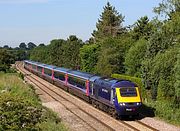 |
43003 Isambard Kingdom Brunel gleams in the early morning sunshine on 22 June 2010 as it passes Wootton Rivers with the 1A75 05:30 Plymouth to Paddington First Great Western service. Quite what the great man would say about having a HST power car named after him is uncertain, but he would probably state that it could go faster than 125 mph if there was more than 4 ft 8½ in between the rails! |
|
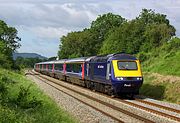 |
With a toot and a wave from the driver, 43003 Isambard Kingdom Brunel passes Frocester on 9 June 2012 with the 1Z33 08:10 Bristol Temple Meads to York First Great Western staff special. This was taking some of the company's employees for a day out at the Railfest 2012 celebrations at the National Railway Museum. As an ambassador for FGW's highly successful HST fleet, the two original production power cars were chosen, 43002 being on the rear of the train. This section of line between Westerleigh and Standish Junctions is not the normal stamping ground for FGW HSTs, as the company's normal stock on this route is Class 150 or 158 DMUs. |
|
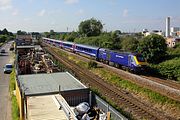 |
43003 Isambard Kingdom Brunel has just passed through Patchway station (just visible in the background), and is picking up speed after coming round the curve between Stoke Gifford and Patchway Junctions. The date is 21 July 2012, and the train is the 1B10 07:45 Paddington to Swansea First Great Western service. Note how the track is starting to split here, with the down line maintaining a higher level towards Patchway Tunnels. Also note the industrial units squeezed between the road and the railway, and the chimney on the Rolls Royce Aerospace site. |
|
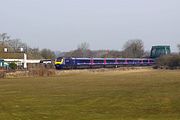 |
43003 Isambard Kingdom Brunel passes Aynho on Sunday 7 April 2013 with the diverted 1Z15 06:50 Paddington to Swansea First Great Western service. Due to engineering works at Reading, trains were travelling to the west via a reversal at Banbury. This train was running 32 minutes late, which was unfortunate, as at the booked time it was a fine sunny morning, with the remnants of the overnight frost in the field. However, high cloud soon appeared leading to very flat lighting, which persisted for most of the rest of the day. |
|
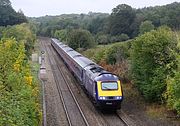 |
Having just emerged from Hailey Wood, 43003 Isambard Kingdom Brunel approaches the southern edge of Sapperton Tunnel on 19 October 2013 with the very late running 1G11 08:15 Paddington to Cheltenham Spa First Great Western service. |
|
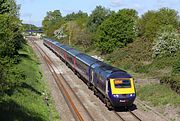 |
An alterative use for a high visibility jacket! 43003 Isambard Kingdom Brunel heads into the morning sun at Baulking on 12 May 2014 with the 1A09 07:02 Taunton to Paddington First Great Western service. The bridge in the background marks the site of Uffington station, formerly junction for the Faringdon branch. |
|
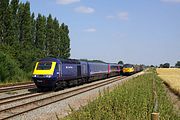 |
A pair of classic 1970s designs at Challow on 30 July 2014. 43003 Isambard Kingdom Brunel speeds westwards with the 1C17 14:00 Paddington to Bristol Temple Meads First Great Western service, while 56113 waits on the relief line with the 6V62 11:22 Tilbury Riverside to Llanwern steel empties. For some reason the driver of 56113 had stopped his train well back from the signal, rather than in the usual spot in the foreground of this picture. This did however enable this passing shot, which would have been impossible otherwise. |
|
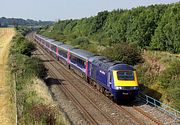 |
43003 Isambard Kingdom Brunel passes Farleaze (near Hullavington) on 10 September 2014 with the 1L51 10:55 Cardiff Central to Paddington First Great Western service. The temporary fencing is to protect the vegetation clearance workforce, who are just out of the picture to the right. This work was in preparation for the forthcoming electrification. |
|
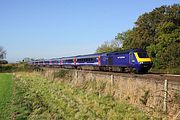 |
43003 Isambard Kingdom Brunel runs along the great man's 'Billiard Table' Great Western Mainline at Uffington on 28 October 2014 with the 1A11 09:30 Bristol Temple Meads to Paddington First Great Western service. With nearly four decades of loyal service on the route, the HSTs have without doubt been the most successful design of passenger train ever to run in this country. |
|
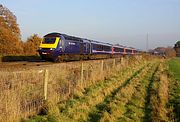 |
Golden autumnal lighting at Uffington on 29 November 2014, as 43003 Isambard Kingdom Brunel speeds westwards with the 1B40 13:45 Paddington to Swansea First Great Western service. The radio mast in the background is on the site of the former Uffington station. |
|
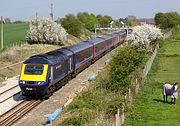 |
The horse in the field at Bourton has been startled by the blast from 43003 Isambard Kingdom Brunel's horn, as it warns track workers of its approach with the 1B48 15:15 Paddington to Cardiff Central First Great Western service on 20 April 2015. Over the previous weekend the track on the up line was renewed and lowered, in preparation for the forthcoming electrification. Isambard Kingdom Brunel is an appropriate name for a loco passing this location, but I wonder what the great man would have made of his line's transformation into an electric railway. |
|
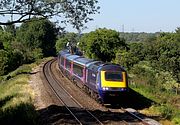 |
43003 Isambard Kingdom Brunel approaches Appleford on 30 June 2015 with the 1P61 15:20 Worcester Shrub Hill to Paddington First Great Western service. The train has just crossed over the River Thames. This is not a particularly pleasant spot to take pictures from, as the roadbridge is very busy, and there is not much room to stand away from the traffic. |
|
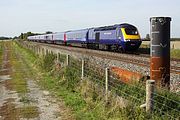 |
43003 Isambard Kingdom Brunel passes signs of impending (probably!) electrification at Steventon 29 September 2015. Not quite the run of the mill GWR HST passenger service, as this is in fact the 5L50 12:37 Cheltenham to Paddington ECS, working to a VSTP (Very Short Term Planning) schedule. Isambard Kingdom Brunel is obviously an apt choice of name for the location, but I wonder what the great man would make of what Network Rail are dong to his superbly engineered line. Presumably he would be impressed by the efficiency and technology of electrification, but like everyone else would be amazed at how badly organised and slow the whole process is! |
|
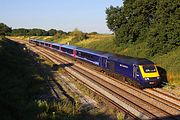 |
Lengthening shadows at Compton Beauchamp on 18 July 2016, as 43003 Isambard Kingdom Brunel speeds westwards with the 1B79 18:45 Paddington to Swansea GWR service. Note the damaged and taped up window near the rear of the first coach. Just in front of the power car a couple of temporary safety handrails mark the site of one of the electrification mast piles, which once complete will render this viewpoint useless for photography. |
|
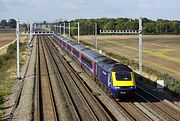 |
43003 Isambard Kingdom Brunel approaches Circourt Bridge, Denchworth, on 10 October 2016 with the 1A11 09:30 Bristol Temple Meads to Paddington GWR service. It is of course entirely fitting that one of the HST fleet should be named after the Great Western Railway's original engineer, but what the great man would have made of the desecration of his superbly engineered route by the hideous electrification scheme, is open to question! |
|
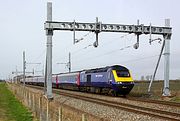 |
43003 Isambard Kingdom Brunel passes the present limit of electrification wiring at Steventon on 1 March 2017, as it heads towards the capital with the 1L38 07:58 Swansea to Paddington GWR service. What would Brunel say about the desecration of his railway with all this ugly ironmongery, when he paid such attention to the aesthetics of his line? |
|
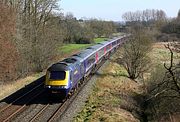 |
43003 Isambard Kingdom Brunel approaches the site of Adlestrop station on 15 March 2017 with the 1W25 12:21 Paddington to Worcester Shrub Hill GWR service. The church and houses of Daylesford can just be glimpsed through the trees in the background. |
|
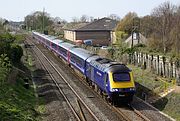 |
43003 Isambard Kingdom Brunel passes Steventon on 26 March 2017 with the 1A20 14:05 Bristol Temple Meads to Paddington GWR service. Note how the electfrication masts stop adjacent to Stocks Lane level crossing, in the background. |
|
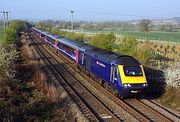 |
43003 Isambard Kingdom Brunel passes Chilson on 7 April 2017 with the 1P26 06:42 Hereford to Paddington GWR service. A clean power car, and early morning spring sunshine make a perfect picture, but I would have preferred the '90 Glorious Years' vinyl covered 43027, which was on the rear, to have been on the front! It seems that the view across the Evenlode Valley will be obscured in years to come, judging by the newly planted trees in the field on the right. |
|
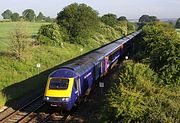 |
Early morning at Charlbury on 14 June 2017, and even near midsummer's day the shadows are causing problems. 43003 Isambard Kingdom Brunel approaches the station with the 1P12 05:28 Hereford to Paddington GWR service. |
|
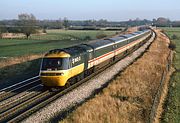 |
43004 leads the 1B26 11:0 Paddington to Swansea InterCity service past the site of Ashbury Crossing, near Shrivenham, on 10 December 1986. By this date the Class 253 set numbers were being disbanded, so it presumably doesn't matter that the 253002 number on the front is incomplete. |
|
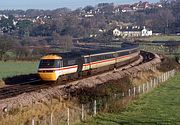 |
43004 rounds the sharp curve at Aller on 7 December 1988 with the 1C16 08:10 Paddington to Penzance InterCity service. Just visible on the extreme right is the 10:50 Paignton to Cardiff Central Class 155 DMU approaching the junction from the south. |
|
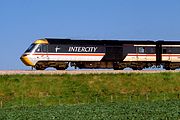 |
With their sleek streamlined front end, HST power cars are the ideal candidate for a spot of panning photography. 43004 speeds past South Stoke on 27 May 1989 with the 1B42 16:43 Paddington to Cheltenham InterCity service. Photo taken from the footpath between the villages of South Stoke and North Stoke, in the Thames Valley. |
|
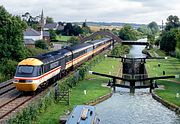 |
43004 runs alongside the Kennet & Avon Canal at Little Bedwyn on 24 August 1996 with the 1C15 08:35 Paddington to Paignton service. Unfortunately this view is no longer possible, as that scrappy little beech hedge next to the line is now a fully grown photographic obstruction! |
|
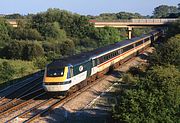 |
43004 Borough of Swindon slowly approaches Wolvercote Junction on 14 August 1997 with the 1B48 17:10 Paddington to Hereford Great Western Trains service. 43304 had been named a few months earlier to celebrate the creation of the Borough of Swindon, splitting it administratively from the rest of Wiltshire. It seems that a 'Merlin' liveried power car with a complete rake of InterCity stock was quite common on this train at the time. I saw exactly the same combination exactly one month earlier! |
|
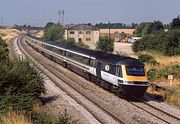 |
43004 Borough of Swindon passes the site of Shrivenham station with the 09:32 Swansea to Paddington First Great Western service on 31 July 1999. This is one of the very few picture I have of a Great Western liveried power car with a complete rake of stock in the later First Great Western 'fag packet' livery. At around this time I was chasing all over the country seeking out freight workings hauled by heritage traction (especially Class 37s) prior to the decimation of services and the replacement of proper locos by Class 66s. Unfortunately this resulted in me neglecting my home patch and not getting as many pictures of the Great Western HSTs as I would have liked. Note that this power car has a modified livery, the whole front area under the lights being painted dark green. |
|
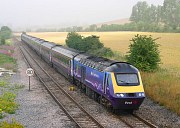 |
Before the general adoption of the rather bland blue livery to the refurbished First Great Western fleet, 43004 First for the future / First ar gyfer y dyfodol received the 'Neon' wavy line livery that later became the standard coach livery. It is seen here emerging from the fog at Crofton on 21 July 2006 with the 05:35 Plymouth to Paddington First Great Western service. The sun was already burning off the dense fog, as can be seen by the sunny patch crossing the wheat field in the background. |
|
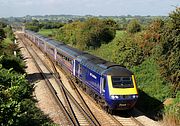 |
43004 passes Fairwood on 11 September 2007 with the 1A86 06:43 Penzance to Paddington First Great Western service. Although 43004 is in the later plain version of FGW's purple livery, all except the rear coach are in still in the first version of this colour scheme. |
|
 |
43004 First for the future / First ar gyfer y dyfodol passes Uffington on 10 February 2009 with the 1B31 12:15 Paddington to Cardiff Central First Great Western service. The chance of getting some pictures of snow with the sun out was not to be missed! |
|
 |
43004 First for the future / First ar gyfer y dyfodol approaches Oxford on 23 May 2009 with the 1P31 07:10 Hereford to Paddington First Great Western service. Note the green signal and feathers on the up relief line on the right. 165128 is signaled for the 09:27 Oxford to Bicester train. |
|
 |
A wide view for a change. 43004 First for the future / First ar gyfer y dyfodol heads through the Vale of White Horse at Baulking on 17 April 2010 with the 1C21 16:00 Paddington to Bristol Temple Meads First Great Western service. The completely clear sky is not just the result of the sunny conditions, but also the total ban on aircraft movements due to the cloud of ash drifting across from the volcanic eruption of Eyjafjallajökull (I've no idea how you pronounce it!) in Iceland. |
|
 |
43004 First for the future / First ar gyfer y dyfodol leads the 1A11 09:30 Bristol Temple Meads to Paddington First Great Western service past Bourton on 28 August 2010. Surprisingly, given the ever increasing number of masts in the countryside, the tall one on the right disappeared a few years after this picture was taken! |
|
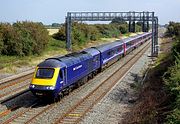 |
43004 First for the future / First ar gyfer y dyfodol speeds past Denchworth on 8 September 2014 with the 1C12 11:30 Paddington to Bristol Temple Meads First Great Western service. A shutter speed of 1/2000sec is essential for this type of picture, and quick reactions! |
|
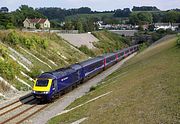 |
43004 emerges from Chipping Sodbury Tunnel on 10 September 2014 with the 1B40 13:45 Paddington to Swansea First Great Western service. The sun was playing hide an seek, but although the background is in shadow, at least the important part of the picture is well lit. |
|
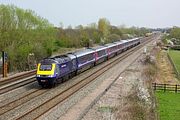 |
A busy moment at Circourt Bridge, Denchworth, on 16 April 2015. 43004 First for the future / First ar gyfer y dyfodol heads west with the 1C14 12:30 Paddington to Bristol Temple Meads First Great Western service, while the balancing 1A17 12:30 Bristol Temple Meads to Paddington recedes into the distance. Stopped on the relief line is 66729 Derby County with the late running 6M40 11:56 Westbury to Stud Farm ballast empties. Note the red, green, and amber aspects on the signals by the bridge in the background. |
|
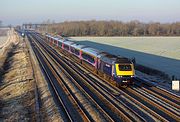 |
43004 First for the future / First ar gyfer y dyfodol passes Circourt Bridge, Denchworth, on the frosty morning of 20 January 2016 with the late running 1L28 07:07 Worcester Shrub Hill to Paddington GWR service. |
|
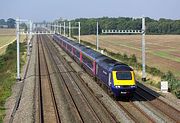 |
43004 First for the future / First ar gyfer y dyfodol passes the partially completed catenary at Circourt Bridge, Denchworth, on 14 September 2016, as it heads towards London with the 1L38 07:59 Swansea to Paddington GWR service. |
|
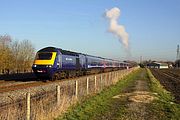 |
In superb winter afternoon light, and with the steam from the gas fired Didcot B Power Station almost emulating the output from the now demolished coal fired Didcot A, 43004 passes Steventon on 5 January 2017 with the 1B37 13:15 Paddington to Cardiff Central GWR service. This was one of the last mast free areas of the Great Western Mainline, but the much delayed electfrication finally caught up with even this location a few weeks later. |
|
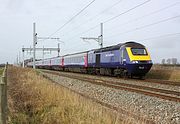 |
The weak sun tries to break through the clouds at Steventon on 1 March 2017, as 43004 speeds towards London with the 1L42 07:30 Carmarthen to Paddington GWR service. At this time the electfrication works ended just a few yards further on. |
|
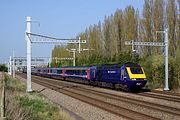 |
43004 speeds past Challow on 6 April 2017 with the 1A10 09:00 Bristol Temple Meads to Paddington GWR service. The view has already been ruined, but I thought it prudent to record the transitional scene, before the wires are attached, purely for the historic record. |
|
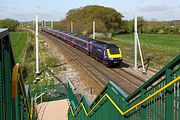 |
The view from the newly opened footbridge at Uffington on 11 April 2017. 43004 heads towards London with the 1L36 08:31 Cheltenham Spa to Paddington GWR service. In all the years that I have been photographing trains at the former footpath crossing, and from the field on the left, I cannot remember anyone else using the footpath. It was slightly ironic then that on my first visit to this new footbridge, a woman walking her dog used it. It seems that the bridge wasn't built just for me after all! |
|
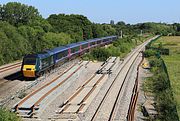 |
43004 passes Wolvercote on 25 June 2018 with the 1W31 15:22 Paddington to Great Malvern GWR service. This just typifies the appalling level of service passengers on the Cotswold Line can now expect. Despite leaving London on time, it managed to become nearly half an hour late. This late running got worse, and then the train was terminated at Worcester Shrub Hill. |
|
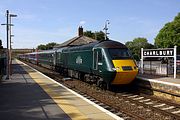 |
43004 arrives at Charlbury station on 7 August 2018 with the 1P37 15:51 Worcester Foregate Street to Paddington GWR service. Plenty of cars in the car park, but a virtually deserted station. That all changes when the rush hour trains arrive from London! |
|
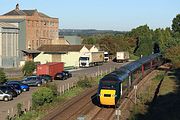 |
43004 passes FWP Mathews flour mill at Shipton on 13 September 2018 with the 1P18 06:42 Hereford to Paddington GWR service. Although recent vegetation clearance ha opened up this view, it is still (and always has been) a very unbalanced composition for a eastbound train. A train heading in the other direction makes a much more balanced picture. |
|
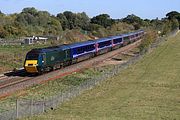 |
43004 passes Hungerford Common on 24 September 2018 with the 1C82 13:03 Paddington to Plymouth GWR service. Now the trees have gone, this view is even more open than it was in the 1980s, thanks to the removal of a redundant PW hut. On the minus side, the trees shielding the sewage works in the background have also gone! |
|
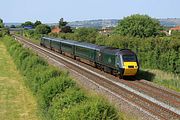 |
43004 Caerphilly Castle passes Brent Knoll on 14 June 2023 with the 2C81 15:51 Bristol Temple Meads to Taunton GWR service. This is my first visit to this location for many years, and unlike a lot of formerly open spots, this one hasn't become overgrown. |
|
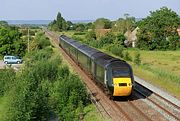 |
43004 Caerphilly Castle brings up the rear of the 2U26 17:11 Taunton to Bristol Temple Meads GWR service at West Hewish on 14 June 2023. The closure of the Severn Tunnel for engineering works prevented this from continuing on to Cardiff, as it normally would. |
|
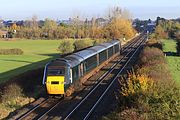 |
43004 Caerphilly Castle brings up the rear of the 2E53 07:38 Bristol Temple Meads to Worcester Foregate Street GWR service at Claydon on 11 November 2023. 43153 Chûn Castle is leading. Looking at the background, it's a good job that I decided not to go to Ashchurch for this, as that area is clearly under some unforecast early morning clouds. |
|
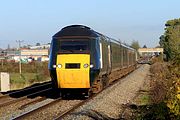 |
43004 Caerphilly Castle accelerates away from Ashchurch station on 11 November 2023 with the 2T43 09:52 Worcester Foregate Street to Bristol Temple Meads GWR service. This is the view from the level crossing at Natton. Note the tree branch sticking out of the roof at the rear of the power car. Presumably this has been snagged from some overhanging tree somewhere on Network Rail's badly maintained network. I can think of a number of locations where the trains brush aside the vegetation! |
|
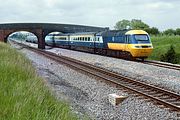 |
43005 passes underneath Denchworth road bridge on 23 June 1979 with the 1A49 11:45 Swansea to Paddington InterCity service. This brick bridge was replaced in the 1990s by a single span structure, with blue engineers brick parapet, and is almost as aesthetically pleasing as this Victorian original. Note how the lineside in the foreground appears to resemble a lush meadow, with plenty of long grass. This is in marked contrast to the overgrown mass of brambles, weeds and assorted bushes that prevails now, since Network Rail stopped maintaining the trackside. |
|
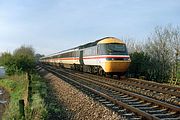 |
43005 passes Bredon's Norton on 14 April 1990 with the 1M55 06:15 Bristol Temple Meads to Liverpool Lime Street. This power car was one of the few that had virtually the whole front end painted yellow at one point in its career, and note how it is starting to show through the grey paint below the windscreen. |
|
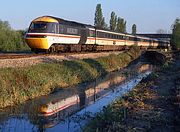 |
A reflected HST at Oxford North Junction on 2 May 1990. 43005 leads the 1M61 17:50 Paddington to Liverpool Lime Street InterCity service underneath the the Aristotle Lane footbridge, and alongside the recently dredged ditch that separated the main line from the route of the former down goods loop. |
|
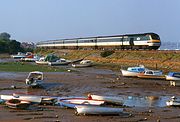 |
Soft evening sunlight at Cockwood Harbour on 3 May 1999, as 43005 sweeps round the curve with the 1C43 14:15 Paddington to Plymouth First Great Western service. Despite the franchise having morphed from Great Western Trains into First Great Western a few months earlier, the entire train is still wearing the former operator's excellent 'Merlin' livery. |
|
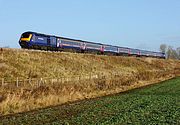 |
With a random mix of old and new liveried coaches, 43005 passes Uffington on 1 December 2007 with the 1C07 09:00 Paddington to Bristol Temple Meads First Great Western service. Unfortunately this viewpoint subsequently became lost due to uncontrolled lineside vegetation. |
|
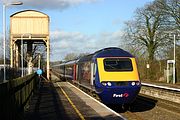 |
43005 brings up the rear of the 11:48 Paddington to Cheltenham 'Cheltenham Spa Express' at Kemble on 30 January 2008. Although a going away shot, the perfect winter light, GWR water tower, and clean First Great Western power car make an excellent picture. |
|
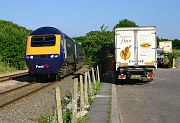 |
This view shows how close the station at Shipton, on the Cotswold Line is to the premises of FWP Matthews, flower millers. On 9 June 2008, 43005 leads the 1W03 17:21 Paddington to Hereford First Great Western service past the company's delivery lorries in the car park. The entrance to the flower mill can be seen on the extreme right, this also being the entrance to Shipton' s down platform, making the narrow path on which I am stood effectively the path to the station. |
|
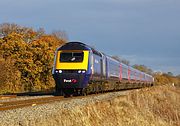 |
In superb lighting, with the dark menacing clouds contrasting with the autumnal foliage, 43005 approaches the site of Wantage Road station with the 1G38 13:48 Paddington to Cheltenham First Great Western service on 17 November 2009. I was surprised at how much foliage was still left on the trees considering the gale force winds of the previous week and the very exposed position of this bank of trees. Needless to say this ideal combination of low sunshine and dark clouds did not last very long. |
|
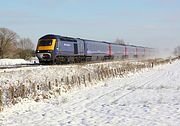 |
43005 speeds through the snowy landscape at Ashbury Crossing, Shrivenham on 7 January 2010 with what is presumably the 1C13 12:00 Paddington to Bristol Temple Meads First Great Western service. It is not that easy to positively identify HST services during periods of bad weather, when late running is the norm. First Great Western were actually canceling some services due to the weather. principally those going to Cardiff. Note how the caked on snow on the front end has mostly fallen off at some point in the journey. |
|
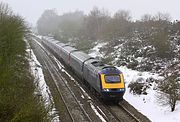 |
A cold misty day at Baulking on 14 January 2010, with some of the previous week's snow still lying on the ground. 43005 heads towards London with the 1L54 11:55 Cardiff Central to Paddington First Great Western service. |
|
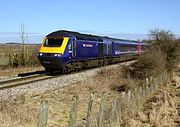 |
With the village of Chadlington just visible in the background, 43005 speeds past Chilson with the 1W02 10:22 Paddington to Hereford First Great Western service on 8 March 2010. This is one location that hasn't succumbed to palisade fencing! In fact the vintage wooden post fence is definitely in need of repair. Note how the top wire has become completely detached from the posts as they drop down into the dip, and is now stretched tight well above the top of the posts. |
|
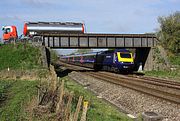 |
Two different forms of transport at Shrivenham on 9 April 2014. An agricultural fertilizer tanker crosses the roadbridge, while 43005 speeds underneath with the 1A10 09:00 Bristol Temple Meads to Paddington First Great Western service. This bridge is due to be reconstructed as part of the Great Western Mainline electrification programme. |
|
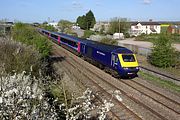 |
The blackthorn is in full bloom at Shrivenham on 14 April 2014, as 43005 speeds through the remains of the old station with the late running 1L32 06:58 Swansea to Paddington First Great Western service. Note the Fat Dog restaurant (formerly the Victoria pub) in the background. |
|
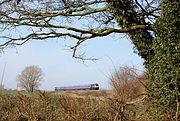 |
Carefully framed by the roadside tree and hedge at Uffington, 43005 heads eastwards on 10 March 2015 with the 1A11 09:30 Bristol Temple Meads to Paddington First Great Western service. As is quite common, this was being held up by the 4L31 09:03 Bristol to Felixstowe North freightliner running in front of it. |
|
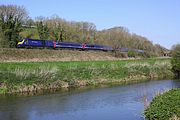 |
43005 passes Avoncliff on 18 April 2015 with the diverted 1C18 14:30 Paddington to Bristol Temple Meads First Great Western service. The River Avon is in the foreground, and the aqueduct carrying the Kennet & Avon Canal over the railway can just be seen in the background. |
|
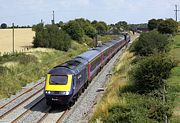 |
43005 passes over freshly ballasted track at Bourton on 8 August 2015 with the 1C14 12:30 Paddington to Bristol Temple Meads First Great Western service. Note that the first class coaches are unusually at the 'country' end of the train. |
|
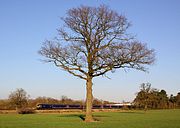 |
A slightly different perspective on a familiar location. 43005 passes Uffington on 24 February 2016 with the 1B48 15:15 Paddington to Cardiff Central GWR service. Not only does the tree provide foreground interest, but it also hides the prominent radio mast! |
|
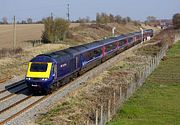 |
43005 passes through the recently cleared shallow cutting at Bourton on 17 March 2016 with the 1B40 13:45 Paddington to Swansea GWR service. Unfortunately this clearance is paving the way for the forthcoming electfrication, which will ruin this location forever. |
|
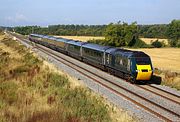 |
My first picture of GWR's second green liveried HST set. 43005 leads the 1A10 09:00 Bristol Temple Meads to Paddington service past Bourton on 1 September 2016. 43041 is the rear power car. At least by late summer the landscape is a contrasting colour to the train's dark green livery, but it still doesn't look right, especially as when clean, as here, it picks up the reflection of everything it is passing! |
|
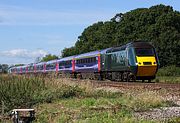 |
GWR green 43005 leads the 5Z70 09:10 Landore to Old Oak Common ECS past Uffington on 23 September 2016, with 'Building a Greater West' liveried 43146 bringing up the rear. So much for keeping the green power cars with their matching coaches! |
|
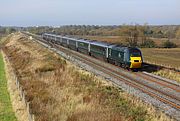 |
43005 passes Bourton on 3 November 2016 with the 1L38 07:58 Swansea to Paddington GWR service. Note the pairs of mast bases on either side of the line near the front of the train. These have been in place for a year, but there is still no other sign here of the stalled electfrication project. |
|
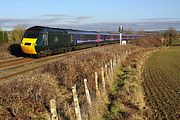 |
43005 brings up the rear of the 1P47 12:06 Worcester Foregate Street to Paddington GWR service at Chilson on 1 December 2016. Theoretically the green power cars are supposed to be kept with their matching coaches, but despite what was mentioned at the time of repainting, that wasn't always going to happen! |
|
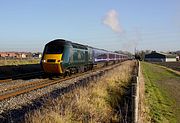 |
43005 passes Steventon on 5 January 2017 with the 1G29 11:36 Paddington to Cheltenham Spa GWR service. A bizarre coincidence resulted in this single green power car on an otherwise blue train being followed just three minutes later by the exact opposite, a blue power car on an otherwise green train! |
|
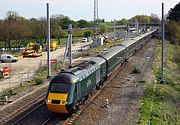 |
43005 passes the electfrication work site at Uffington on 11 April 2017 with the 1B20 09:45 Paddington to Swansea GWR service. This is the view from the newly erected footbridge, which replaces the former footpath crossing. Uffington station, which closed in 1964, was situated near the road bridge in the background. |
|
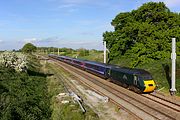 |
A final look at the classic view from the bridge at Compton Beauchamp, before the wires go up and ruin the location forever. The hawthorn is in full blossom, as 43005 speeds westwards on 13 May 2017 with the 1C24 17:30 Paddington to Weston-super-Mare GWR service. Note the two concrete filled steel piles in the foreground, and the masts surely only days away from spoiling the view. |
|
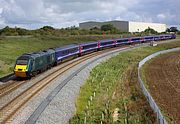 |
43005 brings up the rear of the diverted 1L53 10:24 Swansea to Paddington GWR service, as it climbs the steep curve between Gavray Junction and Bicester South Junction on 17 September 2017. As can be seen from the clouds in the background, sunshine was at a premium (at least until later in the day), and I was lucky that this corresponded with a short sunny period. |
|
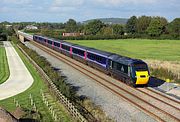 |
Superb evening light at Charlton-on-Otmoor on 17 September 2017, as 43005 heads south with the diverted 1B59 15:58 Paddington to Swansea GWR service. The green power car with blue coaches almost recalls the days in the 1980s when the HSTs were often to be seen with mismatched formations. The difference is the original blue and grey, as well as the later Executive and Swallow liveries were photogenic, whereas the modern versions (especially GWR's uninspired drab green) certainly aren't! |
|
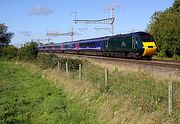 |
43005 leads the 1L38 07:59 Swansea to Paddington GWR service past Uffington on 22 September 2017. The Met Office was quite accurate with the forecast on this occasion, as they had predicted a completely sunny start, with cloud building up by mid morning. This is mid morning, and look what's approaching from the west in the background! |
|
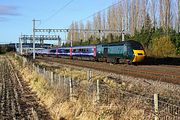 |
Green and blue at Challow on 28 November 2017. 43005 and its mismatched coaches race towards the capital with the 1L24 06:40 Swansea to Paddington GWR service. This trackside location is now the only photographic vantage point here, as the 25kV catenary completely ruins the former excellent view from the bridge in the background. |
|
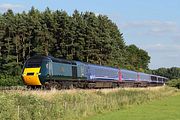 |
Cotswold Line green and blue. 43005 passes Churchill Heath on 22 June 2018 with the 1W02 17:22 Paddington to Hereford GWR service. The footpath crossing on the extreme right links the villages of Lyneham and Bledington, although it seems to be little used, as usually you do not meet anyone else at this remote spot. |
|
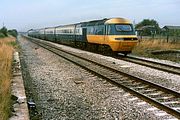 |
43006 passes Challow's long disused platforms on 20 October 1979 with the 1A01 08:05 Swansea to Paddington InterCity service. Note the old Langford & Sons coal office in the background. Photography from locations such as this was perfectly normal (and of course totally safe) in the 1970s. I even remember seeing an article in one of the magazines at the time saying that old platforms like this made excellent photographic vantage points. How times change! |
|
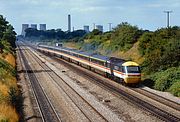 |
The red flag across the up main line gives the game away as to what is happening here. With the main line closed for Sunday engineering work, 43006 has to weave across onto the relief line at South Moreton on 18 August 1991, as it works the 1A46 12:10 Swansea to Paddington InterCity service. 43006 is one of only a handful of the original Western Region allocated power cars that has not spent its entire life on the region. It later moved to the GNER fleet, finally being re-engined and renumbered 43206. |
|
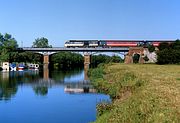 |
43006 crosses the River Avon at Eckington on 25 June 1999 with the 1S41 14:12 Plymouth to Edinburgh Virgin CrossCountry service. Just ten minutes later there was the same InterCity power car / Virgin coach combination from the other direction, followed half an hour later by a full train in Virgin's red colour scheme. |
|
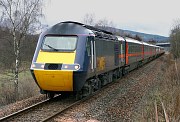 |
43006 Kingdom of Fife speeds past Aldclune (between Blair Atholl and Pitlochry) with the 1E12 07:55 Inverness to Kings Cross GNER 'Highland Chieftain' service on 12 April 2004. The bridge in the background carries the modern A9 road over the line, while I am stood next to the old A9, which used to pass through the villages of Killiecrankie, Aldclune, and Bridge of Tilt. 43006 has subsequently been fitted with a MTU engine and renumbered to 43206 |
|
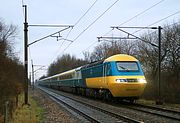 |
43006 passes Arksey on 20 December 2019 with the LNER 1Z48 09:37 Edinburgh to Leeds 'HST Farewell' railtour. This was day three of a four day tour taking the iconic train to all its once familiar parts of the Eastern Region. 43112 is bringing up the rear. Unfortunately late on a dull rainy winter's afternoon is not the ideal time for taking pictures, and it was extremely dark! |
|
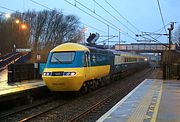 |
43006 brings up the rear of the LNER 1Z48 09:37 Edinburgh to Leeds 'HST Farewell' railtour, as it sweeps through Adwick station in near darkness on 20 December 2019. 43112 is leading. This was day three of a four day 'final HST' tour. |
|
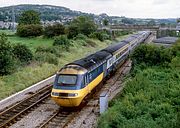 |
43007 leads the 1B22 09:00 Paddington to Weston-super-Mare service past Bathampton on 1 September 1985. This Sunday train was booked to run via the Berks & Hants line, and travel via Hawkeridge Junction and Bradford-on Avon. The rear power car can just be seen leaving the Bradford-on-Avon line at Bathampton Junction. |
|
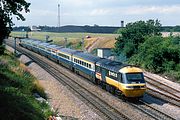 |
43007 approaches Foxhall Junction on 31 July 1986 with the 1A49 12:35 Swansea to Paddington service. Note the huge pile of coal in the background indicating that Didcot Power Station (just out of view to the right) was busy providing power for the national grid. The coal fired Didcot A plant was in use between 1968 and 2013. |
|
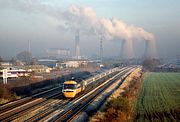 |
43007 leads the 1C52 14:30 Paddington to Bristol Temple Meads service past Milton on 16 November 1988. This was late in the afternoon, and still the fog hadn't really cleared in the background, although it was any improvement on the middle of the day, when Didcot Power Station could hardly be seen through the murk. While this view could have been replicated until recently (albeit with increasing background vegetation), 43007 would not have been seen here in later years, as it moved to Cross Country, and then East Midlands duties. |
|
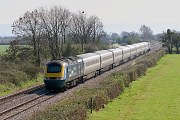 |
On 5 April 2007 a Midland Mainline HST set substituted for a Virgin Voyager on the 1V05 06:05 Derby to Plymouth and 1E47 11:50 Plymouth to Newcastle Virgin services. The latter is pictured passing Claydon with 43007 leading (43072 was on the rear). I would not normally bother taking a picture with such severe backlighting, unless of course it was an evening glint shot, but as I was already waiting on the bridge anyway, why not! |
|
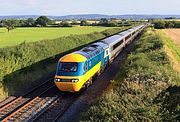 |
To mark the imminent end of CrossCountry HST workings, 43207 was repainted into its original 1970s livery, and given its old 43007 number. It is pictured here passing Fiddington with its first train in this new (old) guise, as it heads north on 16 August 2023 with the 1E63 15:27 Plymouth to Leeds service. The most obvious difference between this and the original HST colour scheme is the black around the updated front lights. |
|
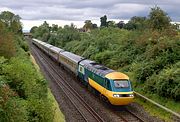 |
Running 23 minutes late, and in atrocious light, 43007 passes Bredon on 25 August 2023 with the 1E63 15:27 Plymouth to Leeds CrossCountry service. The reason for photographing this train in such poor weather was the fact that 43008, which was the rear power car, was making its maiden trip in recently reapplied InterCity Swallow livery. If the weather looks bad here, at least it wasn't raining. However, shortly into my homeward journey it was like a monsoon, with the road resembling a lake, and visibility seriously reduced. |
|
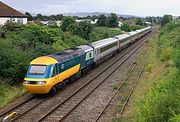 |
After coming to a stand at Alstone Level Crossing (which can be seen in the background), the 1V48 08:11 Leeds to Plymouth CrossCountry service slowly moves off again on 23 August 2023, with 43007 bringing up the rear, and 43008 leading. Note the vintage bullhead track in the well used Cheltenham High Street loop on the right. |
|
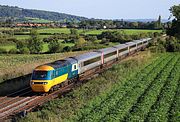 |
43007 passes Defford on 3 September 2023 with the 1S55 14:27 Plymouth to Leeds CrossCountry service. Although it would be nice to see a complete train in the original livery, that would be unrealistic in view of the class's imminent demise. However, the retro liveried power car looks superb, and it has certainly attracted the attention of the country's railway photographers! |
|
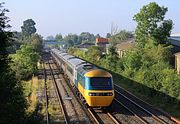 |
43007 brings up the rear of the 1V44 06:12 Leeds to Plymouth CrossCountry service at Ashchurch on 4 September 2023. 43008 is leading, and is just approaching Ashchurch for Tewkesbury station, which surprisingly doesn't appear to have any photographers waiting for it! |
|
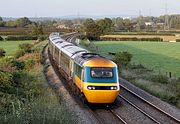 |
The very last CrossCountry HST service disappears into the sunset at Berkley on 18 September 2023, with 43007 bringing up the rear, and 43008 leading. The train is the 1E73 16:27 Plymouth to Leeds service, diverted via the Westbury area, due to engineering works. |
|
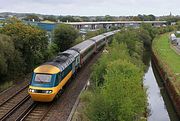 |
43007 passes Poole's industrial estates, as it works the Branch Line Society / CrossCountry 1Z26 14:52 Bournemouth to Swanage 'Bournemouth Belle' railtour on 26 September 2023. I'm used to seeing buddleia, and other garden escapes growing by the side of railway lines, but the various clumps of Pampas Grass (Cortaderia selloana) seen here, are something different! |
|
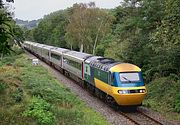 |
43007 brings up the rear of the Branch Line Society / CrossCountry 1Z44 16:18 Swanage to Leeds 'Pines Express' railtour at Stoborough on 26 September 2023. 43008 is leading. This train was run to mark the end of CrossCountry HST operations. |
|
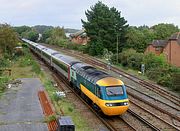 |
43007 passes the disused sidings at Wareham on 26 September 2023, as it brings up the rear of the Branch Line Society / CrossCountry 1Z44 16:18 Swanage to Leeds 'Pines Express' railtour. 43008 is hidden by the bushes at the front of the train. |
|
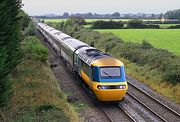 |
HST finale. 43007 brings up the rear of the 5Z43 06:06 Neville Hill to Laira CrossCountry ECS at Claydon on 27 September 2023. 43008 is at the front of the train, heading home after the previous day's 'Pines Express' and 'Bournemouth Belle' railtours. |
|
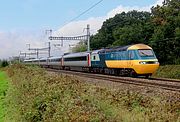 |
43007 passes Uffington on 13 October 2023 with the 5Q46 07:16 Laira to Ely Papworth Sidings ECS. 43378 is bringing up the rear. The off lease power cars and coaches were destined for storage, and then possible export to Mexico. Although HSTs were an everyday sight at this location until 2019, CrossCountry sets would have been extremely rare, so this was definitely not to be missed. It's just a pity that the sun didn't come out until I walking back across the field to the car! |
|
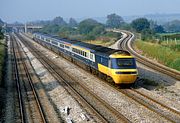 |
Of the original batch of HST power cars that were introduced onto the Western Region in 1976, the majority have not strayed from the area. However, one that did move on to pastures new was 43008. It is seen here passing Llandevenny on 21 October 1985 with the late running 1A32 07:52 Milford Haven to Paddington service. After a spell working with Virgin CrossCountry in the 1990s, 43008 was fitted with a MTU engine in pace of the original Paxman unit, and in this guise works on the other side of the country, on the East Coast Mainline, between London and Scotland. |
|
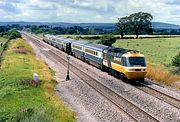 |
43008 passes Badgeworth on 29 July 1986 with the 1M85 10:45 Paignton to Manchester Piccadilly service. The train is very typical of the period, with both power cars in the then relatively new InterCity Executive livery, but all the coaches still in the original blue and grey colour scheme. |
|
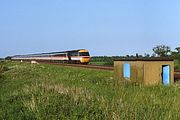 |
The perfect 1980s combination of a sunny evening and Kodachrome 64. 43008 approaches the site of Knighton Crossing on 26 May 1989 with the 1B54 17:59 Paddington to Swansea InterCity service. Judging by the relatively new blue paint on the permanent way hut's door and shutters, it hasn't been that long since it was last in use. Commonplace until the 1970s, these huts were once used for storing tools, and for gangers (as they used to be called) to take their breaks in. Now of course all the track workers arrive by van, along with their tools. |
|
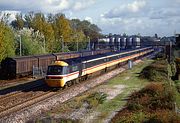 |
43008 passes Norton Fitzwarren on 30 October 1991 with the 1C20 09:35 Paddington to Plymouth InterCity service. Taunton Cider's rail borne traffic had clearly survived the demise of Speedlink a few months earlier, but unfortunately it was not to last much longer. |
|
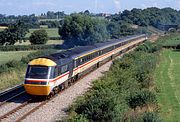 |
Having just left the 1,401 yard long Wickwar Tunnel, 43008 passes Rangeworthy on 13 August 1994 with the 07:09 York to Paignton service. By this date virtually all HST power cars were in this InterCity 'Swallow' livery. |
|
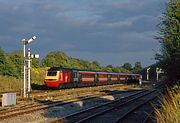 |
Fenny Compton was a fascinating location with its bizarre mixture of upper and lower quadrant signals. The main line was converted to upper quadrant when it was transferred to the London Midland Region after nationalisation. However the sidings and branch to Kineton retained lower quadrant, old and new signals being right next to each other, as seen here. With low evening sun providing perfect lighting, although soon to be extinguished by the dark clouds rolling up from the south. 43008 approaches Fenny Compton with the 1M41 17:20 Bournemouth to Manchester Virgin Cross Country service on 22 July 1999. |
|
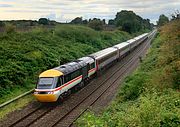 |
Making its debut in InterCity Swallow livery (for the second time in its career), 43008 brings up the rear of the 1E63 15:27 Plymouth to Leeds CrossCountry service at Bredon 25 August 2023. 43007 (also in a 'heritage' livery) was leading. With just a few weeks left in traffic, it's nice to see CrossCountry taking the trouble to pay their respects to Britain's most successful ever train. |
|
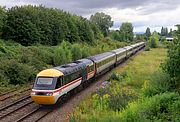 |
43008 slowly passes Alstone on 27 August 2023 with the 1V48 08:11 Leeds to Plymouth CrossCountry service, as it prepares to come to a stand at Alstone Level Crossing. After a brief delay, the train got the 'right away' and proceeded on to Cheltenham station. This was 43008's first train as the leading power car since its recent repaint. As this was moving so slowly, it was easily possible to cross the road for a picture of 1970s liveried 43007, which was bringing up the rear. |
|
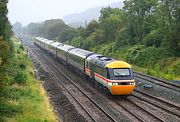 |
Another day, another picture of 43008 in terrible weather! The 1V44 06:12 Leeds to Plymouth CrossCountry service passes Standish Junction in the rain on 28 August 2023, with 43008 leading, and 43007 bringing up the rear. It was partly sunny when I left home, but completely dull after driving a few miles. A few minutes before the train arrived it started raining, only to stop jut after the train had passed. Naturally once back home it was intermittently sunny again! |
|
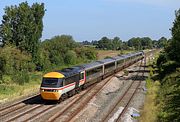 |
With several blasts on the horn to acknowledge the group of photographers on the bridge, InterCity Swallow liveried 43008 passes Standish Junction on 3 September 2023 with the 1V48 08:11 Leeds to Plymouth CrossCountry service. Original blue and yellow liveried 43007 is bringing up the rear. |
|
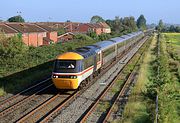 |
43008 approaches Ashchurch on 4 September 2023 with the 1V44 06:12 Leeds to Plymouth CrossCountry service. 43007 is bringing up the rear. This was this set's penultimate day in traffic, before being stored at Laira ready for the CrossCountry HST Farwell railtour on 26 September 2023. |
|
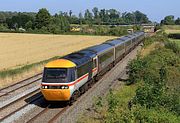 |
43008 passes Spetchley on 5 September 2023 with the 1V50 06:06 Edinburgh to Plymouth CrossCountry service. This was this power car's final run in normal traffic, prior to before being stored at Laira ready for the CrossCountry HST Farwell railtour on 26 September 2023. |
|
 |
CrossCountry HST sunset. The setting sun illuminates 43008, as it passes Berkley with the very last timetabled passenger carrying CrossCountry HST service. This is the diverted 1E73 16:27 Plymouth to Leeds, which had been specially strengthened to eight coaches for the occasion. 43007 is bringing up the rear. The headboard reads: 'CrossCountry High Speed Train Farewell'. |
|
 |
After the storm! The rain has just stopped, as 43008 approaches Didcot North Junction on 26 September 2023 with the Branch Line Society / CrossCountry 1Z43 06:35 Leeds to Swanage 'Pines Express' railtour. I was surprised to be the only person here, as had the sun been out (it was possible!), it would have been one of the few decent locations in the Didcot area. |
|
 |
The Branch Line Society / CrossCountry 1Z25 13:10 Swanage to Bournemouth 'Bournemouth Belle' railtour traverses the causeway over Holes Bay on 26 September 2023, with 43008 leading, and 43007 bringing up the rear. In the background is Pergins Island, a small uninhabited island, densely covered with trees. |
|
 |
43008 passes Stoborough on 26 September 2023 with the Branch Line Society / CrossCountry 1Z44 16:18 Swanage to Leeds 'Pines Express' railtour. Out of sight on the rear is 43007. I had chosen this spot as it is the best location on the former Furzebrook freight line, that now forms the Swanage Railway's mainline connection. Of course the earlier intermittent sunshine had completely disappeared by the time the train was due! |
|
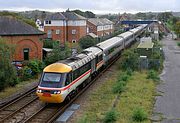 |
43008 leaves Wareham on 26 September 2023 with the Branch Line Society / CrossCountry 1Z44 16:18 Swanage to Leeds 'Pines Express' railtour. 43007 is bringing up the rear. The headboard reads: 'CrossCountry High Speed Train Farewell'. There was an eleven minute stop in the station, and of course most passengers took the opportunity to get pictures, but even now everyone is back on board, the station is still packed, giving an indication of just what a historic occasion this was. |
|
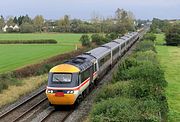 |
A wave and a toot from the driver of 43008, as the 5Z43 06:06 Neville Hill to Laira CrossCountry ECS passes Claydon on 27 September 2023. 43007 is bringing up the rear. This train had been used on the previous day's 'Pines Express' and 'Bournemouth Belle' railtours. The sun was almost on the point of breaking through the clouds, and of course came out fully just a few seconds after the train had passed! |
|
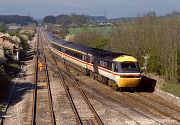 |
A solitary track worker heads off down the track with his shovel as 43009 takes the Westbury line at Fairwood Junction on 18 April 1991 with the 07:35 Plymouth to Paddington service. Compare this view with a very similar picture of 43036 on the equivalent train taken almost exactly three years earlier. Fairwood Farm can be seen in the background with Round Wood just behind. |
|
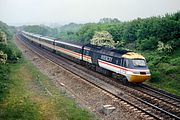 |
A couple of HSTs pass each other at Coalpit Heath on 25 May 1991. 43009 heads for South Wales with the 1B08 08:00 Paddington to Swansea service, while the 1A27 07:32 Swansea to Paddington train disappears into the misty distance. |
|
 |
43009 leads the 1C62 17:45 Paddington to Bristol Temple Meads service past Cholsey on 22 July 1994. This used to be an excellent photographic location prior to electrification, although a row of trees alongside the road from Manor Farm to Lees Cottages annoyingly prevented a wider view than this. |
|
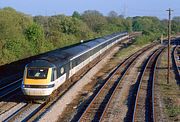 |
43009 passes Hinksey Yard on 28 April 1999 with the 1D62 18:02 Paddington to Oxford First Great Western service. It's a pity that this stylish Great Western Trains livery only lasted for a few years. Unveiled in 1996, the colour scheme suited the HSTs very well, despite the large area of white that must have been difficult to keep clean. By the time that this picture was taken, the company had been bought out by Great Western Holdings, and soon the fleet would be painted in their 'fag packet' livery. |
|
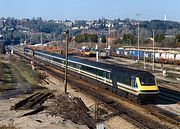 |
43009 leads the 1B26 13:00 Paddington to Swansea service past Ebbw Junction on 15 February 2003. Unfortunately I only have a limited number of pictures of HSTs in First Great Western's 'fag packet' livery, as I didn't realise at the time how short lived the colour scheme would be! |
|
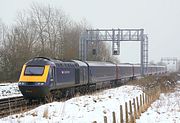 |
43009 First Transforming Travel speeds past the pair of signal gantries at Baulking on 14 January 2010 whilst working the 1B35 12:45 Paddington to Swansea First Great Western service. I expect that when the First Transforming Travel nameplates were first unveiled the name had a bit of a hollow ring with the traveling public, as although FGW had certainly managed to transform travel, late running and chronic overcrowding were probably not exactly the transformation that they had in mind! |
|
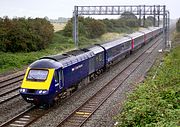 |
Although I took a lot of pictures at this spot near Denchworth prior to the line being electrified, they were usually in full sun. However, for just a change, here is a picture of 43009 First Transforming Travel heading west during a heavy, but fortunately very brief, shower of rain on 16 September 2010. It is working the 1B35 12:45 Paddington to Swansea First Great Western service. |
|
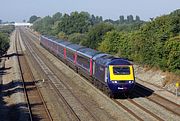 |
43009 First Transforming Travel passes Denchworth on 5 September 2013 with the 1L28 07:08 Worcester Shrub Hill to Paddington First Great Western service. This is a long lens view, as the picture is taken through a signal gantry, which spans the line inconveniently close to the adjacent roadbridge. |
|
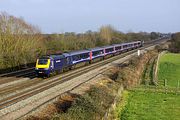 |
43009 First Transforming Travel comes out of the shadows, and into the light, at Circourt Bridge, Denchworth, on 14 December 2013, as it heads westwards with the 1B35 12:45 Paddington to Swansea First Great Western service. |
|
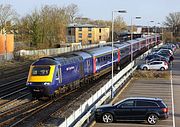 |
43009 pulls out of Oxford station on 1 April 2015 with the 1P21 05:28 Hereford to Paddington First Great Western service. Although still free of the forthcoming overhead electrification wires, there are numerous other non photogenic additions to this viewpoint, since I first started taking photographs in the late 1970s. |
|
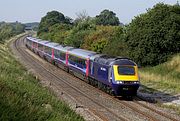 |
43009 passes Compton Beauchamp on 11 September 2015 with the 1L42 08:28 Swansea to Paddington First Great Western service. Note the damage to the horn grille, a not uncommon problem, usually caused by bird strikes. |
|
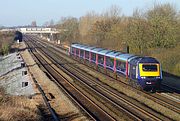 |
A deliberately off centre picture of 43009 passing Denchworth on 18 February 2016 with the 1A09 07:12 Taunton to Paddington GWR service. This long lens view not only shows the works taking place on the left in connection with the forthcoming electfrication, but it also highlights the very poor state of the track on the down relief line! |
|
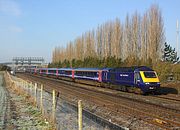 |
43009 passes Challow on 24 February 2016 with the 1L24 06:28 Swansea to Paddington GWR service. A frosty morning, with the sun drifting in and out of some scattered fog patches. Luckily it was full sun for this one! |
|
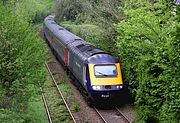 |
43009 passes through the jungle that is the 'Golden Valley' line (Green Valley at this time of year!). The train is the 1L50 10:36 Cheltenham Spa to Paddington GWR service, and is pictured passing Chalford on 13 May 2016. It's not just the lineside vegetation that is nearly touching the train, but on the down line the ballast is almost completely covered in greenery! |
|
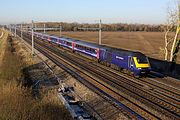 |
43009 speeds past Circourt Bridge, Denchworth, on 1 December 2016 with the 1A10 09:00 Bristol Temple Meads to Paddington GWR service. Note the location of the missing electfrication mast in the foreground, the installation of which will completely ruin this well known photographic vantage point. |
|
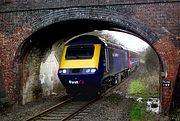 |
43009 speeds underneath the roadbridge at Finstock on 6 March 2017 with the late running 1W01 10:22 Paddington to Hereford GWR service. The bridge seems to be quite leaky, with water dripping down onto the ballast and forming a large pool. Just as the train came into view, a couple of pheasants were walking across the line a short distance down the track. Judging by the cloud of feathers swirling around in the train's wake, at least one of them didn't make it! |
|
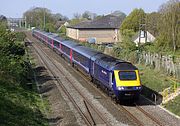 |
43009 passes Steventon in crisp spring light on 6 April 2017 with the late running 1A13 10:30 Bristol Temple Meads to Paddington GWR service. Note the encroaching electfrication masts, which are already up to Stocks Lane level crossing in the background. |
|
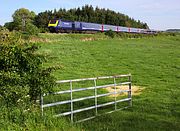 |
43009 passes Lyneham on 22 May 2017 with the 1W32 15:49 Paddington to Moreton-in-Marsh GWR service. Coincidentally, just 15 minutes earlier, consecutively numbered 43010 passed by in the opposite direction with the 1P65 15:14 Hereford to Paddington service. |
|
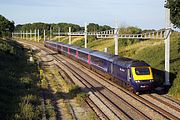 |
43009 passes Compton Beauchamp on 5 July 2017 with the 1C26 18:58 Reading to Weston-super-Mare GWR service. This was during a couple of hours when a number of trains were being cancelled, which obviously explains why this started from Reading at 18:58, and not Paddington at 18:30, as booked. |
|
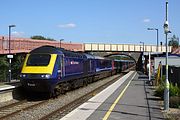 |
43009 brings up the rear of the 1P57 14:25 Great Malvern to Paddington GWR service, as it leaves Honeybourne station on 25 August 2017. Note the change of gradient underneath the bridge. 43027 is at the front of the train. |
|
 |
43009 passes the site of Bremell Sidings on 6 July 2018 with the 1G47 15:36 Paddington to Cheltenham Spa GWR service, which on this occasion was terminated at Gloucester, allegedly due to a points failure. Although not too apparent due to the lineside foliage reflecting in the coach sides, this is a real mixed rake. Both power cards are blue, but the coaches are: green, blue, green, blue, blue, green and blue! |
|
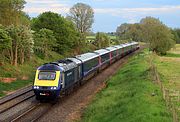 |
43009 passes Daylesford on 18 May 2019 with the final scheduled Cotswold Line HST working, the 1W08 18:22 Paddington to Hereford GWR service. 43185 Great Western is bringing up the rear. After a generally dull afternoon, there was almost a trace of weak sunshine for this, but at the same time there were spots of rain, which is probably why the driver is cleaning the windscreen. As I had photographed the first Cotswold Line HST 35 years earlier, I certainly wasn't going to miss this, regardless of the weather. |
|
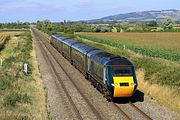 |
43009 passes Fiddington on 26 September 2021 with the 2T39 13:45 Worcester Foregate Street to Bristol Temple Meads service. Sundays sees some of the GWR trains on this route upgraded from Class 158 or 166 DMUs to these four coach HSTs, which normally spend most of their time working between Cardiff and the West Country. |
|
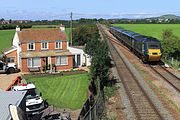 |
With the local landmark of Brent Knoll dominating the background, 43009 Nunney Castle passes Huntspill on 22 August 2023 with the 2C77 13:00 Cardiff Central to Penzance GWR service. 43009 was taken off lease a few weeks later, and in a move that very people would have expected, was then exported aboard the cargo ship Panthera J (along with several other power cars) to Nigeria! |

|
|
